

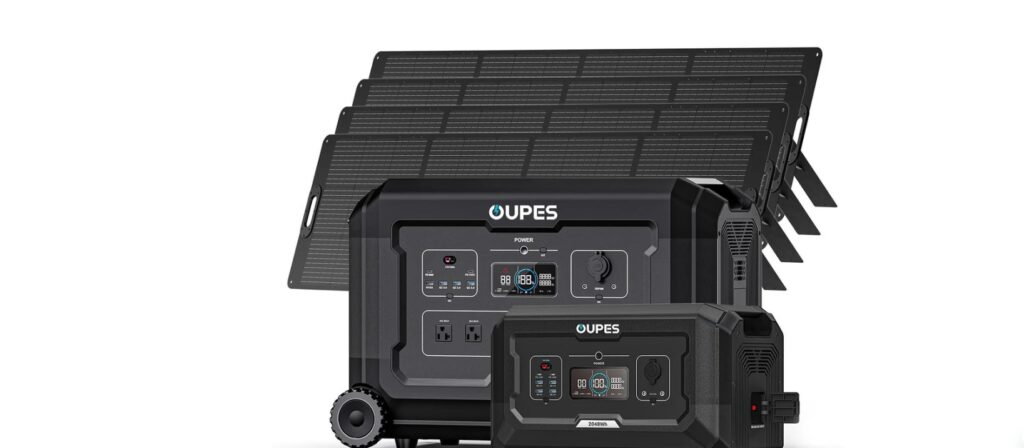
For many homeowners, the monthly electricity bill is a source of financial stress, punctuated by seasonal spikes that seem unavoidable. A significant driver of these high costs is peak demand—those short periods when your home’s energy consumption soars, triggering higher utility rates. While major home renovations like whole-house battery systems are one answer, a more accessible and flexible strategy is gaining traction. Using OUPES portable power solutions to manage and offset your peak energy use can be a remarkably effective way to lower your electricity costs.
This approach centers on “peak shaving,” the practice of reducing your home’s draw from the grid during the most expensive hours. Traditionally, this required complex, permanent installations. Today, modern portable power stations, especially when paired with solar panels, offer a practical entry point. These units allow you to strategically power high-drain appliances from a stored energy reserve, directly cutting the consumption that inflates your bill.
This article will explain the mechanics of peak electricity pricing, demonstrate how portable power can be deployed as a tactical tool for savings, and provide a clear framework for calculating your own potential return on investment. The goal is to move beyond seeing these devices merely as emergency backup and to understand their role in active, ongoing energy management.
Understanding Peak Demand and Your Electricity Bill
To grasp how portable power can save you money, you must first understand how many utilities structure their pricing. Most residential customers are on a tiered rate plan, but an increasing number are being moved to Time-of-Use (TOU) or demand-based rate plans.
TOU plans charge different rates for electricity based on the time of day. Peak periods, typically late afternoon to early evening on weekdays, carry a premium—often two to three times the off-peak rate. This is when air conditioners, ovens, and laundry machines are running concurrently, straining the grid. Demand charges, more common for businesses but trickling into residential plans, bill you based on your single highest 15 or 30-minute period of consumption in a billing cycle. A brief surge can set a high “demand fee” for the entire month.
Your bill, therefore, isn’t just a product of total kilowatt-hours used; it’s heavily influenced by when and how intensely you use them. Reducing consumption during these critical windows yields disproportionate savings.
The Strategy: Peak Shaving with Portable Power
Peak shaving is the deliberate reduction of energy drawn from the grid during peak rate periods. Instead of relying solely on utility power, you supplement it with energy from another source—in this case, a charged portable power station.
Think of it like a hybrid car. The vehicle uses battery power for city driving to avoid inefficient gas engine use, then switches to or combines with gas for highway speeds. Similarly, a portable power station can “take over” for specific, high-wattage appliances during peak hours, allowing your home’s grid draw to remain low and steady. This flattens the demand spike that would otherwise result in higher charges.
The effectiveness of this strategy hinges on three factors: the capacity and output of your power station, your ability to predict and plan for peak hours, and your discipline in shifting specific loads. It’s not about powering your entire home, but about strategically selecting the most impactful devices.
Identifying Your Home’s “Peak Culprits”
A successful peak-shaving plan starts with an audit of your peak-time energy use. Common high-wattage appliances that are ideal candidates for off-grid power include:
- Window or Portable Air Conditioners: A major contributor to summer peak demand.
- Clothes Dryers: Electric dryers are among the top energy consumers in a home.
- Electric Ovens & Stovetops: Cooking dinner often coincides with peak pricing.
- Dishwashers: Especially the heated dry cycle.
- Space Heaters: A key driver of winter peaks.
- EV Charging: Level 1 “trickle” charging can often be shifted to a power station.
Using an energy monitor or simply checking appliance wattage labels will give you a target list. The goal is to choose one or two appliances you can reliably run from a power station for 2-4 hours during peak rate periods.
Implementing an OUPES System for Daily Savings
Putting this strategy into practice requires selecting the right equipment and establishing a simple routine. The core components are a portable power station with sufficient capacity and output, and a method for recharging it economically.
First, choose a power station with a watt-hour (Wh) capacity that can handle your target appliance’s runtime. For example, if you want to run a 500-watt window AC unit for 3 hours during peak time, you need a unit with at least 1,500 Wh of usable capacity (factoring in inverter efficiency, aim for a bit more). Critically, the unit’s pure sine wave inverter must have a continuous output rating exceeding the appliance’s starting and running watts.
Recharging is where the savings compound. To avoid simply shifting grid consumption to a different time, the most cost-effective method is solar. By using solar generators for home backup—a kit that includes solar panels—you can recharge your power station using free sunlight during the day. This creates a true cycle of savings: free solar energy captured and stored, then deployed during expensive peak hours to displace grid power.
A daily routine might look like this: Connect solar panels in the morning to fully recharge the station by mid-afternoon. As peak rates begin, unplug the window AC unit from the wall and plug it into the power station. Run it for the duration of the peak window (e.g., 4 PM to 9 PM). After peak rates end, plug the AC back into the wall and set the solar station to recharge overnight on a low, off-peak rate if needed, ready for the next day.
Calculating the Potential Savings and ROI
The financial return depends on your local utility rates, your consistency, and the equipment cost. Here’s a simplified framework for estimation.
- Identify Your Peak Rate: Check your utility bill for the peak vs. off-peak rate. For this example, assume a peak rate of $0.45/kWh and an off-peak rate of $0.15/kWh.
- Define Your Shifted Load: Let’s say you use a portable power station to run 800 watts of appliances (e.g., a fridge and some lighting) for 4 peak hours daily.
- Calculate Daily Savings:
Energy Shifted = 0.8 kW * 4 hours = 3.2 kWh.
Cost at Peak Rate = 3.2 kWh * $0.45 = $1.44.
Cost to Recharge (on off-peak) = 3.2 kWh * $0.15 = $0.48.
Net Daily Savings = $1.44 – $0.48 = $0.96. - Annualize and Compare to Investment:
Annual Savings = $0.96/day * 365 days = ~$350.
If a suitable solar generator kit costs $1,500, the simple payback period would be just over four years. After that, the savings are pure annual profit. Furthermore, this calculation doesn’t factor in potential utility rebates, rising electricity rates (which would increase your savings), or the invaluable benefit of having a reliable backup power source during outages.
Key Considerations for Success
For this approach to work reliably, you must account for a few practicalities. Battery cycle life is crucial; a quality lithium iron phosphate (LiFePO4) battery, common in better power stations, can withstand thousands of charge cycles, making it suitable for daily use. Weather dependency is a factor if relying solely on solar; having the option to plug into a wall outlet as a backup charging source is wise for cloudy days. Finally, safety is paramount. Always use the system according to the manufacturer’s guidelines, ensure proper ventilation for the unit, and use heavy-duty extension cords rated for the appliance’s amperage if needed.
Frequently Asked Questions
Can a portable power station really power my air conditioner?
Yes, but you must match the specifications carefully. Check your AC unit’s starting watts (surge) and running watts. Choose a power station whose pure sine wave inverter has a continuous wattage rating above the running watts and a surge rating above the starting watts. A 1,500W+ capacity station is often a minimum for smaller window units.
How much can I expect to save on my bill?
Savings vary widely based on your local utility’s rate structure, the amount of load you shift, and how consistently you do it. As illustrated in the calculation section, shifting 3-4 kWh daily from peak to off-peak rates can yield savings of $200-$400 per year in many regions. The more aggressive your peak shaving, the greater the savings.
Is using a power station daily bad for the battery?
Modern portable power stations with LiFePO4 batteries are designed for longevity and can handle daily cycling very well. A quality LiFePO4 battery can retain 80% of its capacity after 3,000+ full charge cycles. Using it daily for peak shaving is a valid use case that fits within the product’s intended lifespan.
Do I need solar panels to make this cost-effective?
While not strictly necessary, solar panels dramatically improve the economics and environmental benefit. Without solar, you recharge from the grid, so you’re just shifting consumption from peak to off-peak hours. You still save due to the rate difference, but solar allows you to use free energy, maximizing both savings and grid independence.
What’s the difference between this and a whole-house battery?
A whole-house battery (like a Tesla Powerwall) is a permanent, high-capacity, automated system that can back up or power your entire home. A portable power station is a lower-capacity, manual, and flexible tool for targeted power needs. The portable solution is a fraction of the cost and offers versatility, while whole-house batteries offer seamless, whole-home coverage and automation.
Conclusion
Viewing portable power stations solely as emergency backup equipment overlooks their significant potential as daily financial tools. By enabling a practical peak-shaving strategy, OUPES portable power solutions effectively transform from occasional-use devices into active participants in your home’s energy management. The process of identifying peak culprits, strategically deploying stored power, and leveraging solar recharging creates a direct path to lowering your most expensive kilowatt-hours.
The initial investment is offset not only by monthly savings on your electricity bill but also by the acquired resilience against power outages. As utility rates continue to climb and grid reliability becomes a growing concern, the value proposition of having a personal, versatile energy reserve only strengthens. This approach empowers you to take control of a portion of your energy costs with a flexible, scalable system that pays for itself over time.