

Open plan living has shifted from trend to standard in modern home design. The desire for fluid, light-filled spaces that encourage connection and flexibility is clear. Yet, the need for occasional privacy, acoustic separation, or simply defining zones within a large room remains. This is where the strategic installation of internal bi-folding doors becomes a transformative solution.
Unlike a single door or a static wall, a set of Internal Bi-Folding Doors offers the best of both worlds. They can be concertinaed fully open to merge spaces completely or closed to create distinct, enclosed rooms. The challenge lies not in deciding if they are right for your home, but in selecting the right set for your specific needs. The wrong choice can lead to operational frustration, visual clutter, or a compromised aesthetic.
Choosing the perfect pair involves a series of interconnected decisions. You must assess the practicalities of your space, understand the performance characteristics of different materials, and align the design with your home’s overall character. This guide walks through each critical consideration to help you make an informed investment that enhances your living environment for years to come.
Assessing Your Space and Configuration
Before you fall in love with a particular style, you must start with the cold, hard facts of your room. The physical dimensions and layout are the primary constraints that will dictate your viable options.
First, measure meticulously. You need the exact width of the opening and the height from floor to lintel. Bi-folding doors require a track at the top (or sometimes the bottom) and stack to one or both sides. The available “stacking space”—the wall area where the folded panels will sit when open—is crucial. For a 4-panel door, you need clear wall space equal to the width of three panels. Insufficient stacking space means the doors will protrude into the room, defeating the purpose of a clean, open feel.
Next, decide on the opening configuration. Doors can stack to one side (left or right hand) or split and stack to both sides (known as a “bi-parting” configuration). A one-sided stack is often simpler and suitable for openings where one side has ample blank wall space. A bi-parting configuration creates a more symmetrical, grand entrance and is ideal for central openings where the doors can disappear into walls on both sides. Consider your furniture layout and traffic flow when deciding.
Choosing the Right Material
The material of your bi-folding doors determines their look, feel, weight, durability, and insulation properties. The three main contenders are timber, aluminium, and uPVC, each with distinct advantages.
Timber
Timber doors offer classic warmth and natural beauty. They provide excellent natural acoustic and thermal insulation, making them a strong choice for separating a living room from a noisy home office or a cooler hallway. High-quality hardwoods like oak are durable but require periodic maintenance such as oiling or varnishing. They are also the heaviest option, which may require more robust tracking hardware. Timber is best for traditional or rustic interiors, or for creating a feature with rich, natural grain.
Aluminium
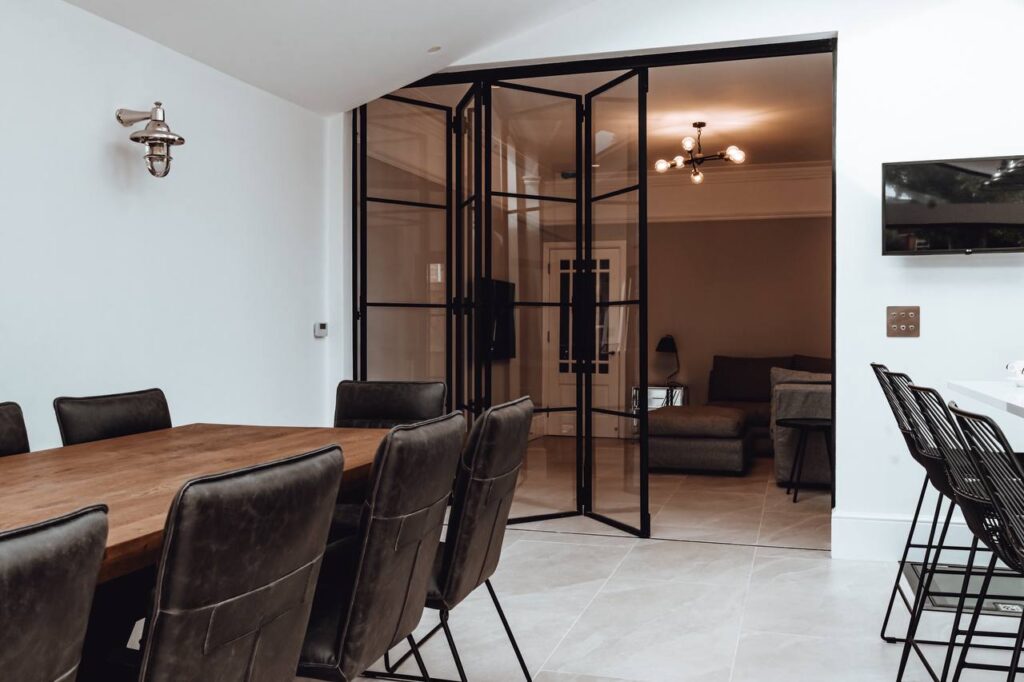
Aluminium is the choice for a contemporary, minimalist aesthetic. Its key strength is its slim sightlines; the frames can be incredibly narrow, maximizing glass area and minimizing visual obstruction. It is strong, lightweight, corrosion-resistant, and requires virtually no maintenance beyond cleaning. Modern thermally broken aluminium frames also offer good thermal performance. While often at a higher price point, aluminium provides a sleek, architectural look perfect for modern open-plan spaces.
uPVC
uPVC is the most budget-friendly and low-maintenance material. It is durable, provides good thermal insulation, and is available in various finishes, including woodgrain effects. The frames are typically thicker than aluminium, so sightlines are less slim. It can be a practical choice for cost-conscious projects or where a consistent look with existing uPVC windows is desired, though it may lack the premium feel of timber or aluminium.
Understanding Glazing and Performance
The panels of your bi-fold doors are not just frames; the glazing is a major component that affects light, energy efficiency, sound, and safety.
For most internal applications, double glazing is standard and recommended. The insulating air gap between the two panes of glass significantly reduces heat transfer and, more importantly for internal use, sound transmission. If you are using the doors to separate a media room or kitchen from a quiet lounge, opting for acoustic laminated glass can dramatically improve sound insulation.
Consider the glass itself. Clear glass maintains full visual connectivity. For more privacy or diffused light, options like frosted, patterned, or textured glass are available. In homes with children, safety-tempered glass is a wise choice for all glazed doors. Also, check the energy efficiency ratings if the doors separate a heated space from an unheated one (like a sunroom), as this will impact your home’s overall thermal envelope.
Hardware, Tracking, and Operational Smoothness
A bi-fold door is only as good as its hardware. The track, rollers, hinges, and handles are the engine of the system, and compromising here leads to doors that drag, jam, or fail over time.
Top-hung systems, where the weight is carried by a track mounted in the header, are most common for internal doors. They allow for a smooth, effortless glide and keep the floor track minimal or even flush, improving aesthetics and ease of cleaning. Bottom-rolling systems exist but are more prone to debris collection.
Look for heavy-duty, ball-bearing nylon rollers for silent operation. The track should be robust, typically aluminium. The choice of handle is both functional and stylistic—a sleek flush pull, a contemporary bar handle, or a traditional lever. Ensure all hardware finishes match your chosen style, from brushed steel to matte black or brass. Investing in quality hardware from the outset prevents costly repairs and daily annoyance.
Integrating Design and Aesthetics
Finally, your doors must look like they belong. Their design should complement your interior architecture, not clash with it.
Frame colour is a fundamental choice. White and black are versatile modern options. Wood stains showcase the natural material. More colours are available in aluminium and uPVC. Match the door style to your home: shaker panels for a classic look, full glazed for modernity, or a combination of solid lower panels with glazed uppers.
Consider the visual impact when closed. A set of Bi-Folding Internal Doors should appear as a cohesive wall or elegant partition, not an afterthought. The finish on both sides is important, as internal doors are often viewed from both rooms. The ultimate goal is a feature that enhances the space whether fully open, partially closed, or shut for privacy, seamlessly integrating into your open plan living vision.
Frequently Asked Questions
What is the minimum width needed for internal bi-fold doors?
There is no absolute minimum, but practical and aesthetic considerations come into play. Very narrow openings (under 1.2 metres) may be better served by a single or double door. Bi-folds truly shine on wider openings, typically from 1.8 metres upwards, where they can create a dramatic, wide aperture. Always consult with a supplier for the specific system’s minimum panel width.
Can internal bi-fold doors provide good sound insulation?
Yes, they can provide significantly better sound insulation than a standard single door or an open archway. The level depends on materials. A solid timber door with double glazing, especially with acoustic laminated glass, will offer the best performance. Ensuring a proper seal with quality perimeter draught excluders is also critical for blocking sound transfer.
Are they suitable for separating a kitchen from a living area?
Absolutely. This is one of their most popular applications. They allow you to open up the space for entertaining and close it to contain cooking smells, noise, and visual clutter. Choose easy-clean materials like aluminium or uPVC, and consider glazing options that maintain light flow while potentially obscuring a messy counter from view.
How much maintenance do they require?
Maintenance varies by material. Aluminium and uPVC require very little—just occasional cleaning of the glass and frames. Timber doors will need periodic re-finishing (oiling, varnishing, or painting) to protect the wood and maintain its appearance. All types benefit from regular lubrication of the track and moving parts to ensure smooth operation.
Do I need to reinforce my floor or ceiling?
For most internal top-hung systems, the weight is carried by the lintel or header above the opening. Your installer will assess the structural suitability. Standard timber or metal stud partitions can usually support the weight with appropriate fixing. Concrete or solid walls are not an issue. Floor reinforcement is rarely needed for internal doors, as they are not load-bearing.
Can they be fitted into an existing opening?
In most cases, yes. They are an excellent retrofit solution for replacing a static wall, a pair of French doors, or a single doorway to create a larger opening. A professional installer will survey the opening to ensure the structural header is sound and can support the tracking system, and will make any necessary adjustments to the aperture size.
Conclusion
Selecting the perfect internal bi-folding doors is a deliberate process that balances spatial logistics, material performance, and cohesive design. It begins with honest measurements of your room and an understanding of how you want the space to function daily. From there, the choice between the warmth of timber, the sleekness of aluminium, or the practicality of uPVC sets the tone, supported by decisions on glazing and the critical hardware that ensures effortless operation.
When chosen correctly, these doors become more than a functional divider; they are a dynamic architectural element that gives you masterful control over your living environment. They empower you to redefine spaces on demand, catering to quiet family evenings, large gatherings, or focused work. The result is an open plan home that is truly adaptable, blending form and function in a way that static walls simply cannot match. Your investment pays dividends not just in property value, but in daily living quality.